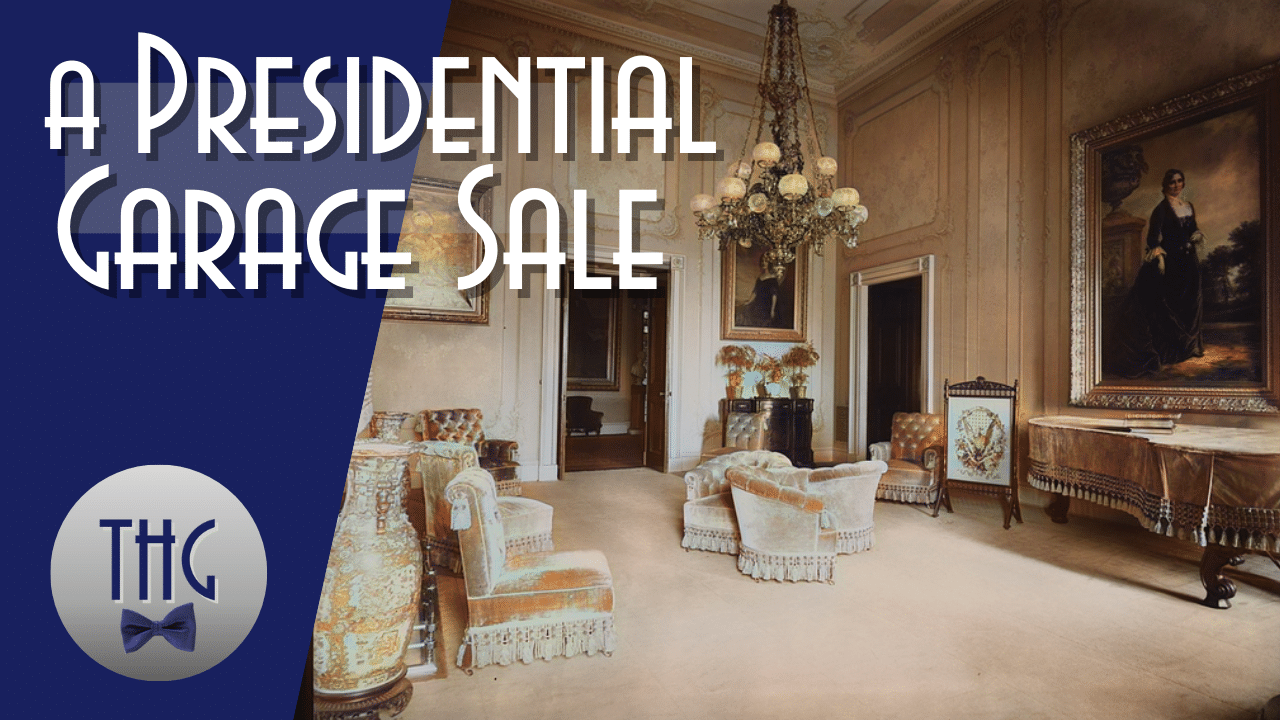
White House Garage Sale
The Unexpected President
Chester Arthur never expected to be president. He had only become the vice presidential nominee when the Republican convention failed to find a
candidate that satisfied both the “Stalwart” and “Half-Breed” wings of the party. They finally settled on the “Dark Horse” candidate James Garfield, who brought along Arthur to satisfy the Stalwarts.
The 1880 election was incredibly close in the popular vote, with neither party obtaining a majority. There is historical disagreement about the exact popular vote, with most historians agreeing that in a vote of over 8 million, the Republicans won by fewer than 10,000 votes – the official government tally puts the victory margin at fewer than 2,000 votes. The Electoral college vote was, however, decisive, 214-155. Garfield and Arthur were officially inaugurated on March 4th, 1881.
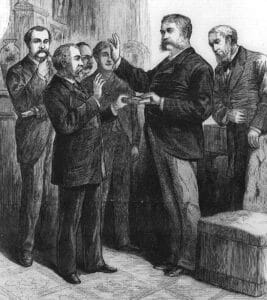
Garfield’s presidency would not last long. On July 2, he was walking with his Secretary of State, James Blaine, when a disgruntled and unstable office seeker named Charles Guiteau, who believed his work on the Garfield campaign entitled him to a diplomatic position, shot him in the back. Garfield lay sick for months in the White House. Many doctors at the time didn’t believe in anti-sepsis techniques or cleanliness to prevent infection. He died September 19th. Arthur, who was at his home in New York City, took the first news of his death with fear: “I hope—my God, I do hope it is a mistake”. Official confirmation came soon after, and he was sworn in in the early hours of September 20th.
The White House in 1881: An Aging Wreck
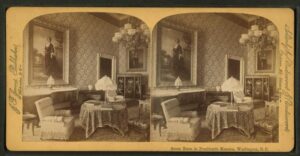 The White House of 1881 was in rough shape. Congress did not appropriate enough money for White House repairs and redecoration, although the house was steadily modernized with things like indoor plumbing and running water. Beginning in 1833, congress increased the appropriation for redecoration for each incoming administration to $20,000, but it was often not enough to replace worn out furniture and do necessary upgrades and repairs. One of the difficulties was that before WWII, the grounds and even the White House itself were broadly open to the public without invitation or appointment, and they often snipped off pieces of fabric or curtains as souvenirs.
Arthur was not a man of simple taste. He was known as the “Gentleman Boss” and “Elegant Arthur”, and was rumored to own 80 pairs of pants – a ridiculous luxury for the time. He was called a “novel species of President”, a “type that is represented by the well-dressed and well-bred New Yorker – the quiet man who wears a scarf and a pin in it and prefers a sack coat to the long – tailed frock coat”. Arthur was also known for his lavish carriage, “a dark green landau, picked out with red, drawn by two perfectly matched mahogany bays with flowing manes and tails.”
Operation: Redecoration
Arthur refused to even move into the White House before it was redecorated more to his exquisite taste, and ordered the work to begin as soon as Lucretia moved out. Arthur’s wife had died suddenly of pneumonia in January, 1880, only months before Arthur was elected vice president, so Arthur’s sister Mary took over most of the hosting jobs that a First Lady was responsible for. Arthur, however, was keenly interested in the work that he ordered for the remodel, and oversaw it closely. William Henry Crook, who served the White House for more than fifty years beginning in 1865, said that Arthur “generally came to the Executive Mansion every evening after dinner, and made a thorough inspection…Night after night he would go from room to room and corridor to corridor, giving orders to change this and that according to his own taste.”
That taste was the height of opulence for the Victorian era, gilded and upholstered in lavish silks and inlaid silver. W. B. Moses and Son did much of the redecorating, including installing ebony chairs carved in “the japanese style” that had been ordered by Lucretia Garfield in the East Room, as well as some other furniture that went to the Green Room.
In addition to Moses and Son, Arthur hired Louis Comfort Tiffany and his company “Louis Comfort Tiffany and Associated American Artists” to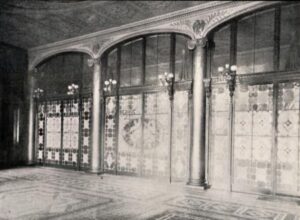 decorate the Executive mansion. Tiffany’s work was largely relegated to regilding and glass work, for which he was already famous. In the White Houses’ main corridor, the walls were painted pale olive with gold leaf, and the ceiling was decorated with gold and silver traceries that spelled out “USA”. Most impressive of Tiffany’s work was the replacement of a clear glass screen that separated the Entrance hall from the cross hall with a massive and fashionable piece of colored glass. Fifty feet in length and reaching from floor to ceiling, it had “a motif of eagles and flags”, along with a shield, stars, and the initials “US”. The large screen remained in place for twenty years, when it and most every other example of the Victorian style was removed by Theodore Roosevelt; the screen went to a hotel, and was later destroyed in a fire. Arthur finally moved into the White House in December of 1881.
A Presidential Garage Sale
Of course Arthur’s redecoration brings to mind another question: what happened to the many old, worn-out or outdated pieces of furniture, carpets, and other “junk”? In what appears to be the largest single removal of former presidents’ goods up to that time, Arthur had it packed up and sent to auction. The Vermont Phoenix of Brattleboro, Vermont, recorded that “24 loads of cast-off furniture from the white house” were sold, “the first sale of the kind since Buchanan.” Buchanan had sold at least fifty pieces of furniture in 1860, but Arthur sold not only the twenty four wagonloads but “other articles”, including thirty barrels of China.
It isn’t clear exactly what was sold at the auction, as no detailed list of the items exist. We know that the items were sold by the Duncanson Brothers, auctioneers in Washington DC, on April 14th, 1882. An ad for the sale in The Baltimore Sun lists “unserviceable furniture, carpets, chandeliers, mantels, etc. from the Executive Mansion. Comprising parlor suits, window hangings, arm chairs, etc.” It also lists carpets from the East Room, and “Rosewood and other furniture in sofas, lounges, bedsteads, bureaus, washstands, screens, mattresses, etc.”
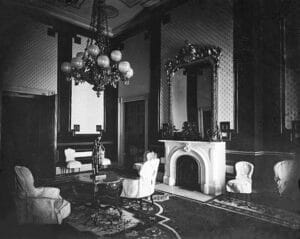 Other lists include “the entire furniture of the east room” which was moth-eaten, furniture from the Red Parlor and Green Room, maps, marble mantels, two high chairs for children which had been ordered by President Hayes, lead piping, stoves, a “good-sized geographical globe” that had belonged to Nellie Grant, a pair of President Lincoln’s trousers, and several rat traps, “including the historical one in which the rat which ate up President Lincoln’s suit of clothes was caught.”
Newspaper reports say upwards of 5,000 people attended the auction, which raised about $6,000, over $165,000 in 2022 dollars. The Wyandotte Gazette of Kansas City, Kansas, reported that “it brought remarkably high prices… more than they originally cost”. Former president Rutherford Hayes bought two wagons worth of furniture – including two mahogany serving tables bought during James Madison’s administration, which now sit in Hayes’ home, part of the Rutheford B Hayes presidential library and museums in Spiegel Grove, Ohio.
Sadly, though, it is not known where most of the times went– including that “Historical” rat trap. We are left wondering if someone actually wore Lincoln’s trousers. The mantels were later missed – when Truman gutted the house between 1948-1952 the designers bemoaned that they had only 3 of the original 24 1818 mantels purchased during James Monroe’s tenure.
Arthur’s casual sale of worn and “unfashionable” items is surprising today, especially the lack of care given to even enumerating what was sold. Additionally, Arthur’s redecoration spoke to the new city-bred man of a changing nation, less rural and more metropolitan, and defined, of course, by the opulence and gold of the American Gilded Age.
Since Arthur’s time, many items have been sold or donated from the White House collection, although more modern presidents have generally relied on a large collection of carpets, desks, rugs, and furniture to furnish the residence as well as the Oval Office. Congress now appropriates $100,000 per administration for redecoration, although some modern presidents have chosen instead to use private money for decoration. In 1961 Congress passed a law declaring the furnishings of the White House to be inalienable property of the White House, as well as legislating the House’s status as a museum.
Featured Articles

Related Videos