Dandelions and Civilization
The Ancient History of Dandelions
As a species dandelions are believed to have evolved about thirty million years ago in Eurasia, and spread widely during interglacial periods, when receding glaciers left wet, disturbed land in their wake. Dandelions thrive especially in disturbed habitats where there is little competition.
Dandelions have been an important part of the human diet for most of history. They are easily foraged, and provide important nutrients without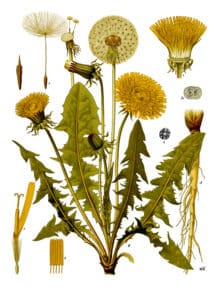 needing any care. All parts of the plant are edible. The leaves have been traditionally eaten raw or boiled, and are used to make dandelion teas. The flowers themselves have been described as “sweet,” although the plant becomes bitter as it grows older. Thus, the best tasting dandelions are picked in spring. The roots, which are thick and go deep into the ground, can be peeled and eaten like other roots, such as carrots, or ground and made into a kind of “coffee”.
Dandelions were a well established part of diets all over the ancient world, and were eaten by Ancient Greeks, Romans, and Egyptians. The Greeks still eat them today in a traditional dish called radikia. It is even mentioned in Greek myth; John Evelyn published the Acetaria, a discourse on salads, in 1699, and in it he says of dandelions it “was from this homely sallet, that the good wife Hecate” fed Theseus, the slayer of the Minotaur.
The Dandelion as Medicine
The plant is also believed to have been used as a folk medicine well into prehistory, especially in China. The first written record of its use as a medicine comes from tenth century Arabic texts, where writers refer to it as a kind of endive called “tarakhshaqūn”, which means ‘bitter herb’, and from which the scientific name taraxacum is thought by some to have been derived. Others suggest it came from the Greek ‘taraxos’, meaning disorder, and ‘akos’ meaning remedy. The common name, “dandelion”, is a corruption of the french ‘dent-de-lion’, from the latin dens leonis, or tooth of the lion. In Middle English, it was known as “piss-a-bed”. Many other languages also call it “lion’s tooth”. It isn’t clear why this name became popular, but historians have suggested that the serrated leaves resemble teeth, or that the familiar yellow flower looks like a mane. One clever 15th century surgeon claimed the name came from the way the plant was as effective as a “lion’s tooth” in combating certain diseases.
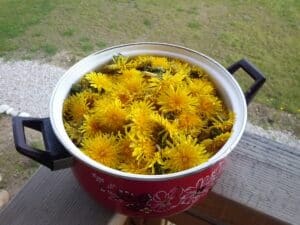 Medicinally the plant has been used as a diuretic, as a digestion aid, as an anti-inflammatory, and to treat kidney and liver disease. The white latex that comes from the hollow stem has been used as a folk remedy for warts. The plant is remarkably nutritious, high in vitamins A, C, and K, and also potassium, iron and zinc. It was used by Normans, Anglo-Saxon tribes, and medieval Europe to prevent or treat scurvy. It was mentioned in Chinese herbals as early as the seventh century. It’s recognized medical benefits have been enshrined in its scientific name: the term Officinale, referring to apothecaries, was reserved only for herbs and plants that had a long history of being therapeutic. Modern studies have identified viable medicinal properties of the plant.
European peasants included it frequently in their gardens, and used it to make dandelion wine, salads, and tea. It was also often included in the ubiquitous herb gardens of Monasteries and lords. A book describing medicinal properties of herbs by Elizabeth Blackwell in the mid eighteenth century mentions dandelions were “much eaten as a salad in the spring”.
Arrival in the New World
While there are several species of dandelion native to North America, it wasn’t until Europeans arrived that T. Officinale reached American shores. The plant may have been brought deliberately by the puritans as a food or medicinal crop on the Mayflower in 1620. The seeds also travelled by accident, along with shipments of other grasses and cultivates. The plant quickly became naturalized across the world, and though it is introduced it is usually not considered invasive.
Native Americans quickly incorporated the plant into their own medical knowledge. The Ojibwe and Iriquois peoples of the North East used it as a fever reducer and anti-inflammatory, and the Aleut, Shoshoni, Cherokee, Paiute, Apache, and Kiowa peoples were all familiar with the plant as a medicine or food.
Why a Weed?
So why are dandelions now reviled as a noxious weed? Their fall from human grace was tied to the rise of the front lawn.
 Lawns began in the 17th century in England, as a display of wealth: only the ultra rich could afford large, non-productive green spaces. From there it travelled to the US: Thomas Jefferson was among the earliest to emulate the idea at Monticello. In the US, the lawn became a part of the American Dream: In “The Great Gatsby”, Nick Carroway narrates that “We both looked at the grass—there was a sharp line where my ragged lawn ended and the darker, well-kept expanse of his began.”
As the lawn became ubiquitous, the dandelion changed from a sometimes useful but common plant into a menace, ruining the uniformity of lawns from coast to coast. In 1944 the weed killer known as 2,4 D was discovered, almost simultaneously, by several different groups in the US and UK. In 1945 the American Chemical Paint Company introduced “Weedone”, which killed broad-leaved plants but not grasses. The things that made dandelions desirable as a food and medicine soon made them a problem. Shallow rooted lawns are frequently disturbed, providing ideal habitat for the plant. The taproot grows so thick and deep that the Chinese called it “earth nail”. Other plants and medications made the mild dandelion mostly obsolete, and now it remains mostly in the places people don’t want it.
But even today it isn’t universally despised. During WWII, The Empire of Japan controlled most of the world’s rubber production. One possible solution appeared in the Kazakh dandelion, which was cultivated in the United States, Europe and the Soviet Union as an emergency supply of rubber, to some success, though never in large quantities. Today, unstable rubber prices, damaging fungus, and worries about growth have led to efforts to economize the kazakh dandelion as a source of rubber, and to some, the future looks promising.
Should You Eat It?
There are still people today who eat dandelions, but in the modern world there is reason to be cautious eating out of your front yard, where pesticides, fertilizers, and other pollutants can impact the plant. If trying dandelion, start small to determine if you have any food sensibilities or allergies, and, while the whole plant is edible, the stems exude a waxy substance that can cause nausea in some people.
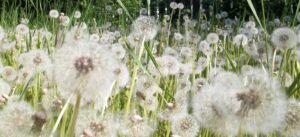
It is a supreme irony that we now wage war on a plant that is here because we brought it as a staple food and reminder of home. Some modern movements seek to rebrand the dandelion and speak to its history or its use as a food. Others even celebrate the plant and its many uses. Each May, the town of Vineland, New Jersey celebrates with an annual Dandelion Dinner in honor of the town’s agricultural history. In Japan a dandelion appreciation society has bred many colorful varieties purely for their beauty. Perhaps in the future the perception of dandelions will shift once again, or perhaps it will continue to be just a weed. But it will remain an important part of human history.
Featured Articles

Related Videos