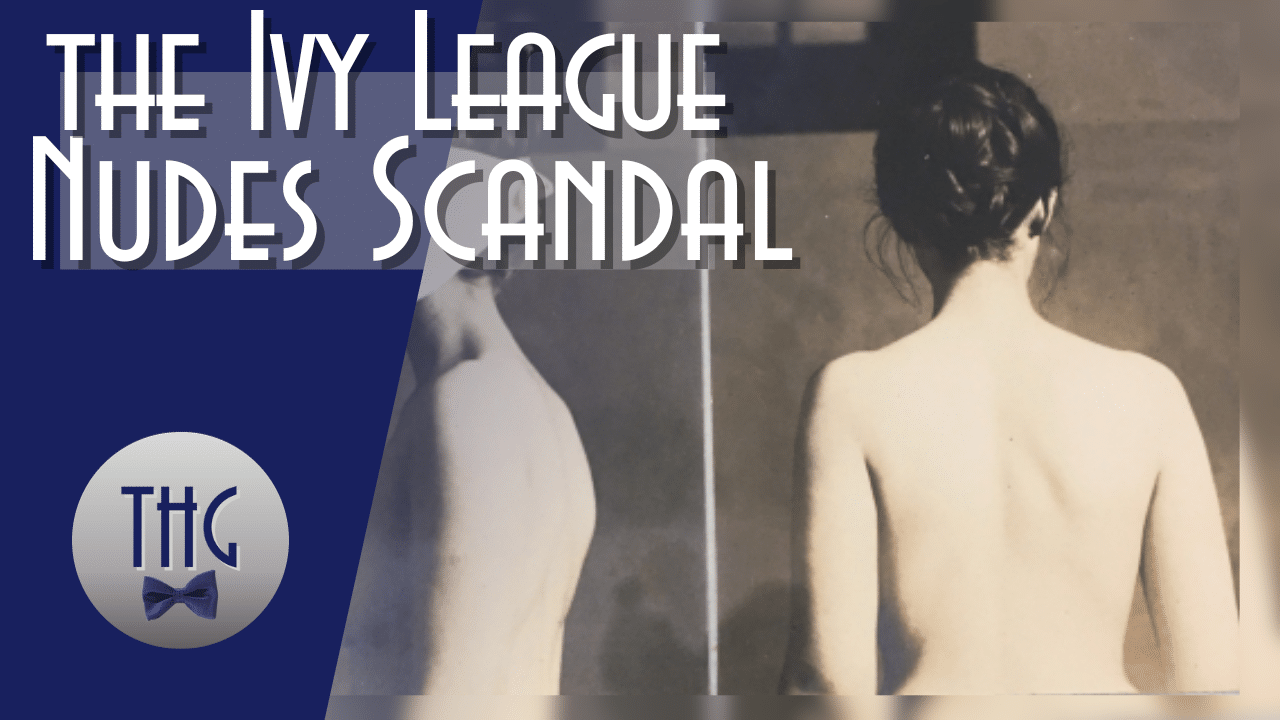
The Ivy League Nude Photo Scandal
Between the 1940s and the 1970s, many college freshman at prestigious universities were expected to strip down during orientation. It was not meant to be titillating, but a part of a scientific study meant to examine spinal conditions and posture. Unfortunately the real motivations behind the experiment were somewhat darker.
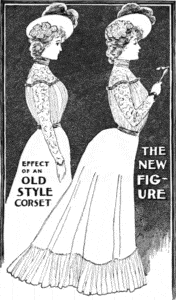 Our conceptions of good posture are not as ancient as we might think. Before the 1800s, “languid slouching” and relaxed posture was emphasized in social settings in England, a movement that spread to America. After the 1750s, however, more modern ideas of posture, including stiff backs and straight necks. The shift in both America and Europe was realtively quick, as manners books like Lord Chesterfields’s Advice to His Son, On Men and Manners emphasized straight posture as gentlemanly, and an 1817 pamphlet by Emma Parker advised women that posture was becoming an important measure of virtue, and that women’s bodies “should partake as little as possible in the motion of the limbs.” It tied into racist ideas as well: phrenologists argued that Europeans had a particular predilection for posture in their bones and spines, unlike “less civilized races of men”.
Bu by the late 1800s reactions against this “stuffiness” had formed, and more relaxed furniture, clothing, and posture, became the norm, especially among the young, who viewed the Victorian formality as old fashioned. In turn, the loosening of social restrictions led to a just-as-powerful backlash. In 1872 Doctor Dan Newcomb wrote When and How, a child-rearing manual. One panel showed contrasting children – one had healthy and happy children playing outside, while the other had twisted, ugly children sitting indoors with piles of books. The caption read “Which?” “There is a growing opinion that our physical degradation must find a stopping place,” Newcomb wrote. A 1917 study found that 80% of Harvard’s freshmen had poor posture.
The new angle was one of health. Dr. D. F. Lincoln blamed schooling, claiming that bending over desks was causing spinal damage. Dr. Edmund Shaftesbury argued that posture improved not only “physical and hygienic” issues, but had a “moral effect on the whole body”. Poor posture was a major driver of the physical education movement. Schools became a central place to enforce good posture and examine students for spinal and posture issues like scoliosis and rickets. Higher education got in on the game as well, with colleges like Vassar and Harvard beginning to include posture tests in the 1880s. The most robust posture programs took hold in north eastern colleges of the Ivy League and Seven Sisters schools.
Entire generations of Americans were subjected to the ordeal, which many remembered with horror. Many of these students went on to become important figures in politics, entertainment, and other fields – people like Hilary Clinton, George Bush, Meryl Streep, Bob Woodward, and more. Rumors constantly swirled that the photos had been stolen or otherwise acquired, and would be published or sold in some kind of black market.
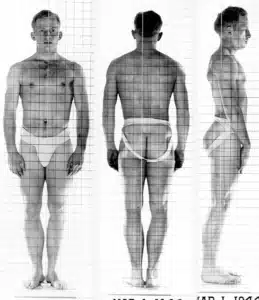
Much worse, however, was hiding behind these photos. In the 1940s, psychologist William Herbert Sheldon formulated his theory of somatotyping, which categorized humans into three types, which he believed were connected to temperaments, and indicated a person’s intelligence, morality, and potential. He took and appropriated thousands of photos, including many taken at colleges, often without the subjects knowledge or consent. He published his Atlas of Men using thousands of nude photographs in 1954, and planned a similar Atlas of Women. The Harvard Crimson claims that people who knew Sheldon “describe him as a racist and a Nazi-sympathizer,” and he believed that Hispanic and African brains stopped maturing earlier than whites’. A contemporary researcher, physician Robert Holt, called Sheldon’s work “a dangerous piece of fascistic pseudo-science.” Sheldon got a hold of large numbers of nude images from colleges in various ways, to use in his research.
 Sheldon would die in 1977, his life’s work discredited and his career in shambles, after word of what he was doing got out in 1950. A surprisingly dark turn for a movement that began in the pursuit of good posture.
The scandal of the nude photos – some of which have gotten out into the public – became well-known after a piece written by Ron Rosenbaum for The New York Times in 1995, titled “The Great Ivy League Nude Posture Photo Scandal”. Many of the remaining photographs have been destroyed, although the Smithsonian still holds a number of them. American still struggle with the issue of posture, but hopefully we will find solutions that don’t involve nude photographs.
Featured Articles

Related Videos